Showing posts with label lipids. Show all posts

Sunday, September 27, 2015

Should you drink your coffee filtered?


Coffee is one of the most widely consumed beverages in the world. Arguably a key reason for this is that coffee has psychoactive properties that we may be hardwired to value, even if subconsciously. For example, it increases alertness; possibly a fitness-enhancing effect in our evolutionary past. Here the term “fitness” in “fitness-enhancing effect” means “reproductive success”, and does not mean having great athletic ability or having shredded abs.

The two most common sources of coffee beans, which are roasted and ground prior to brewing, are the widely favored Coffea arabica, and the "robusta" form Coffea canephora. The arabica form accounts for 80 percent or so of world consumption. The graph below, from a study by Bonita and colleagues (), shows the per capita consumption of coffee in various countries. As you can see, Scandinavian countries are big consumers.


Most people probably drink filtered coffee. However, there are many unfiltered coffee preparation methods that are also widely used. Greek coffee, Turkish coffee, coffee prepared with a French press, and “cowboy coffee” are all unfiltered.

In the photo below (from: Goldenstate.wordpress.com), illustrating cowboy coffee, note that the coffee pot is placed near but not over the fire.


What is “cowboy coffee”? This method of preparation has many variations. A simple one involves mixing ground coffee with hot water, and then keeping the coffee simmering on very low fire for a while. It is called cowboy coffee due to its association with coffee drank by cowboys around a campfire.

After brewed, coffee tends to rise and spill out of the pot if heated at a high temperature. To avoid this, one should turn off the fire just prior to the coffee boiling, heat the coffee in a pot on very low fire, or heat the coffee by placing the pot near but not too close to a campfire. The same is generally true for tea.

With cowboy coffee you need significantly less coffee per measure of water, and the coffee ends up with a stronger flavor – if prepared properly. You also keep two key oily components of the coffee, namely the diterpenes known as kahweol and cafestol; its polyphenols, most notably chlorogenic acid; and some of the coffee particles.

Both kahweol and cafestol seem to be associated with reduction in certain types of cancer in humans, and show strong anti-cancer effects in rats (). The same seems to be generally true for chlorogenic acid (). The coffee particles, if ingested, would probably be treated as indigestible fiber and promote colon health. This is usually the fate of indigestible and partially digestible plant matter.

Why is filtered coffee often recommended? Well, unfiltered coffee is believed to promote heart disease. But that is not primarily due to any strong association having been found between unfiltered coffee consumption and heart disease. In fact, the absence of evidence in favor of this hypothesis in long-term studies is rather conspicuous ().

The belief that unfiltered coffee can promote heart disease is due to evidence showing that consumption of 4 cups per day of unfiltered coffee raises total cholesterol by up to 10 mg/dl ().

Only diehard proponents of the lipid hypothesis would look at total cholesterol increase as a marker of heart disease, in part because total cholesterol may increase due to an increase in HDL cholesterol – a much more reliable marker, but of protection against heart disease, particularly within certain ranges. And yes, unfiltered coffee consumption is associated with an increase in HDL cholesterol ().

Moreover, some of the metabolites of caffeine, 1-methyxanthine and 1-methyluric acid, appear to help prevent LDL oxidation; caffeine metabolites also seem to have potent anti-inflammatory properties ().

Some research provides evidence of the importance of moderation in coffee consumption as an important factor in its relationship with health. In this respect, coffee is like almost anything that can be ingested, including water – the dose makes the poison. In a study of 40,000 post-menopausal women in the US reviewed by Bonita and colleagues (), the hazard ratio of death attributed to heart disease was 0.76 for consumption of 1–3 cups/day, 0.81 for 4–5 cups/day, and 0.87 for ≥6 cups/day. Interestingly, the same study reported that the hazard ratio for death from other inflammatory diseases was 0.72 for consumption of 1–3 cups/day, 0.67 for 4–5 cups/day, and 0.68 for ≥6 cups/day.

Frequently you hear about the possible connection between coffee consumption and gastritis. The most widely cited study I could find that looked into this link found no association between coffee consumption and reflux-associated gastritis ().

By the way, if you have gastritis, you should consider getting tested for Helicobacter pylori (), especially if you like eating raw fish.

Stress and coffee consumption may have similar effects in those who test positive for Helicobacter pylori (see, e.g., ). In those individuals, past research has found a link between: (a) stress, coffee consumption, and other purported “stomach irritants”; and (b) exacerbation of gastritis symptoms, stomach ulcers, and stomach cancer.

This discussion on gastritis is largely unrelated to the issue of drinking unfiltered coffee. It is unclear based on the past studies that I reviewed whether coffee filtration has anything to do with any possible connection between coffee consumption and exacerbation of gastritis symptoms caused by other factors.

As a side note, it is important to keep in mind that the acidity of coffee is nowhere near the acidic of gastric acid, which the stomach is uniquely designed to handle.

I may be wrong, but from what I can see, if you drink coffee regularly and it causes no problems for you, drinking unfiltered coffee is not a bad idea at all.

Thursday, May 27, 2010

Postprandial glucose levels, HbA1c, and arterial stiffness: Compared to glucose, lipids are not even on the radar screen

Postprandial glucose levels are the levels of blood glucose after meals. In Western urban environments, the main contributors to elevated postprandial glucose are foods rich in refined carbohydrates and sugars. While postprandial glucose levels may vary somewhat erratically, they are particularly elevated in the morning after breakfast. The main reason for this is that breakfast, in Western urban environments, is typically very high in refined carbohydrates and sugars.

HbA1c, or glycated hemoglobin, is a measure of average blood glucose over a period of a few months. Blood glucose glycates (i.e., sticks to) hemoglobin, a protein found in red blood cells. Red blood cells are relatively long-lived, lasting approximately 3 months. Thus HbA1c (given in percentages) is a good indicator of average blood glucose levels, if you don’t suffer from anemia or a few other blood abnormalities.

Based on HbA1c, one can then estimate his or her average blood glucose level for the previous 3 months or so before the test, using one of the following equations, depending on whether the measurement is in mg/dl or mmol/l.

Average blood glucose (mg/dl) = 28.7 × HbA1c − 46.7
Average blood glucose (mmol/l) = 1.59 × HbA1c − 2.59

Elevated blood glucose levels cause damage in the body primarily through glycation, which leads to the formation of advanced glycation endproducts (AGEs). Given this, HbA1c can be seen as a proxy for the level of damage done by elevated blood glucose levels to various body tissues. This damage occurs over time; often after many years of high blood glucose levels. It includes kidney damage, neurological damage, cardiovascular damage, and damage to the retina.

Most regular blood exams focus on fasting blood glucose as a measure of glucose metabolism status. Many medical practitioners have as a target a fasting blood glucose level of 125 mg/dl (7 mmol/l) or less, and largely disregard postprandial glucose levels or HbA1c in their management of glucose metabolism. Leiter and colleagues (2005; full reference at the end of this post) showed that this focus on fasting blood glucose is a mistake. They are not alone; many others made this point, including some very knowledgeable bloggers who focus on diabetes (see “Interesting links” section of this blog). Leiter and colleagues (2005) also provided some interesting graphs and figures, including eye-opening correlations between various variables and arterial stiffness. The figure below (click to enlarge) shows the contribution of postprandial glucose to HbA1c.


Note that the lower the HbA1c is in the figure (horizontal axis), the higher is the postprandial glucose contribution to HbA1c. And, the lower the HbA1c, the closer the individuals are to what one could consider having a perfectly normal HbA1c level (around 5 percent). That is, only for individuals whose HbA1c levels are very high, fasting blood glucose levels are relatively reliable measures of the tissue damage done be elevated blood glucose levels.

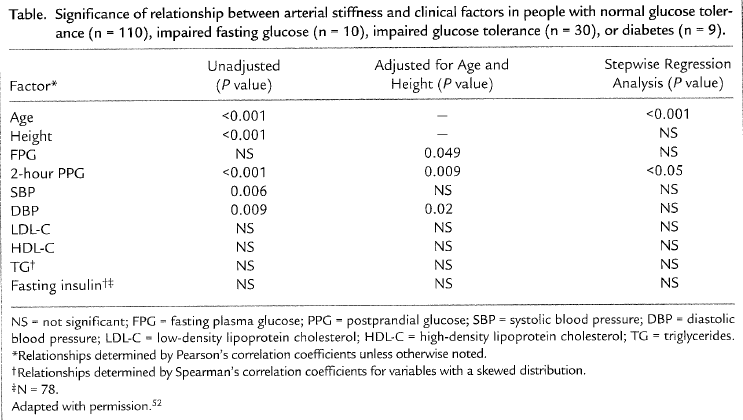
The table below (click to enlarge) shows P values associated with the impact of various variables (listed on the leftmost column) on arterial stiffness. This measure, arterial stiffness, is strongly associated with an increased risk of cardiovascular events. Look at the middle column showing P values adjusted for age and height. The lower the P value, the more a variable affects arterial stiffness. The variable with the lowest P value by far is 2-hour postprandial blood glucose; the blood glucose levels measured 2 hours after meals.


Fasting glucose levels were reported to be statistically insignificant because of the P = 0.049, in terms of their effect on arterial stiffness, but this P value is actually significant, although barely, at the 0.05 level (95 percent confidence). Interestingly, the following measures are not even on the radar screen, as far as arterial stiffness is concerned: systolic blood pressure, LDL cholesterol, HDL cholesterol, triglycerides, and fasting insulin levels.

What about the lipid hypothesis, and the “bad” LDL cholesterol!? This study is telling us that these are not very relevant for arterial stiffness when we control for the effect of blood glucose measures. Not even fasting insulin levels matters much! Wait, not even HDL!!! A high HDL has been definitely shown to be protective, but when we look at the relative magnitude of various effects, the story is a bit different. A high HDL’s protective effect exists, but it is dwarfed by the negative effect of high blood glucose levels, especially after meals, in the context of cardiovascular disease.

What all this points at is what we could call a postprandial glucose hypothesis: Lower your postprandial glucose levels, and live a longer, healthier life! And, by the way, if your postprandial glucose levels are under control, lipids do not matter much! Or maybe your lipids will fall into place, without any need for statin drugs, after your postprandial glucose levels are under control. One way or another, the outcome will be a positive one. That is what the data from this study is telling us.

How do you lower your postprandial glucose levels?

A good way to start is to remove foods rich in refined carbohydrates and sugars from your diet. Almost all of these are foods engineered by humans with the goal of being addictive; they usually come in boxes and brightly colored plastic wraps. They are not hard to miss. They are typically in the central aisles of supermarkets. The sooner you remove them from your diet, the better. The more completely you do this, the better.

Note that the evidence discussed in this post is in connection with blood glucose levels, not glucose metabolism per se. If you have impaired glucose metabolism (e.g., diabetes type 2), you can still avoid a lot of problems if you effectively control your blood glucose levels. You may have to be a bit more aggressive, adding low carbohydrate dieting (as in the Atkins or Optimal diets) to the removal of refined carbohydrates and sugars from your diet; the latter is in many ways similar to adopting a Paleolithic diet. You may have to take some drugs, such as Metformin (a.k.a. Glucophage). But you are certainly not doomed if you are diabetic.

Reference:

Leiter, L.A., Ceriello, A., Davidson, J.A., Hanefeld, M., Monnier, L., Owens, D.R., Tajima, N., & Tuomilehto, J. (2005). Postprandial glucose regulation: New data and new implications. Clinical Therapeutics, 27(2), S42-S56.